Asking the Fed what mortgage rates will do is like asking a sprinter to predict a marathon.
The Fed sets one number: what banks charge each other overnight.
Your mortgage, on the other hand, is a 30-year loan, and it’s priced off the 10-year Treasury bond. That bond is US government debt that investors buy, and its yield moves with what investors expect for inflation and how risky they think it is to lend for ten years.
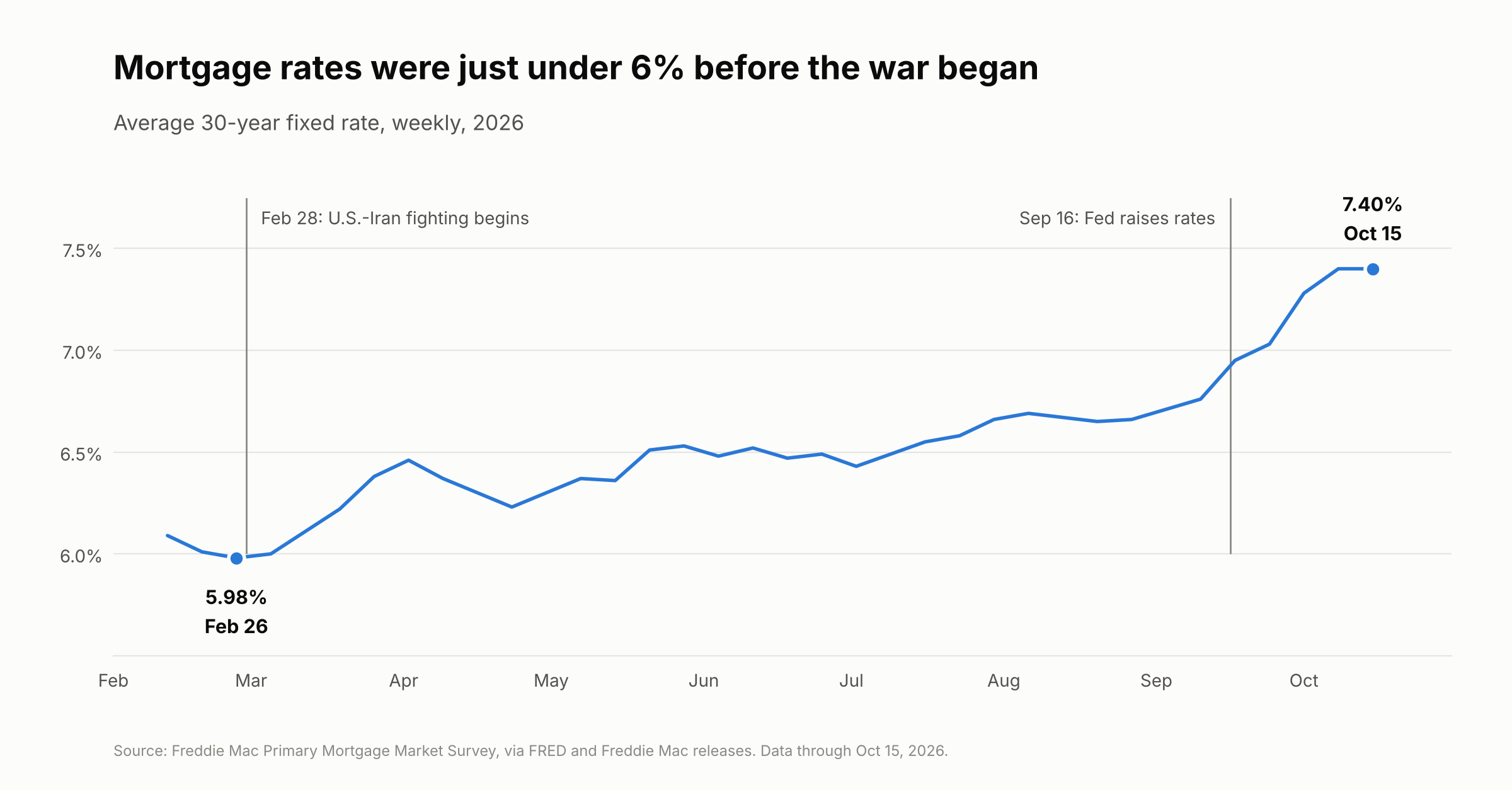
In mid-February the average 30-year mortgage was about 6%. Eight months later, on October 21, it was 7.40% for conforming loans and 7.65% for jumbo (per Mortgage News Daily). And the Fed held its rate steady through July, while mortgage rates climbed anyway.
So why did mortgage rates jump?
Look at the timing. Fighting between the U.S. and Iran began February 28. The 10-year Treasury yield was just under 4% before that. It’s now above 5%.
Here’s the chain. Oil shipments through the Strait of Hormuz were suddenly at risk. Oil jumped, and that fed into the price of nearly everything that gets shipped, made, or built. Inflation is running around 3.5%. Anyone lending money for ten years wants more for taking that risk, so they demand a higher yield. Mortgage rates follow.
Add a second problem: nobody knows the rules
Tariffs and unpredictable trade policy pile on. Investors will still hold U.S. debt, but they ask for more to hold it when the rules keep changing. The war is the biggest piece and the trigger. Tariffs, deficits, and the Fed’s first hike since 2023, in September, are all in the mix too.
What it costs
On a $1.6 million loan, 6% is about $9,600 a month. At 7.65% it’s about $11,350. That’s roughly $1,750 more every month for the same house.
What would bring rates down
The same things, in reverse.
- More stability abroad. A real de-escalation gets oil supply back to normal and takes the inflation worry out of the bond market.
- More predictable trade policy. Markets can price a tariff. They can’t price not knowing what changes next week.
- Confidence in how Washington is run. Bond investors pay a premium for calm, steady governing and charge a penalty for chaos.
None of that runs on a calendar. If things settle, I could see rates drift back toward the mid-6s over the next year. I wouldn’t plan around 6% in the near term.
What you can do while you wait
You don’t have to wait on the 10-year. In the right deal, a seller or lender can help buy down your rate, which can cut your monthly payment more than a price reduction of the same size.
The sprinter doesn’t control the marathon. But you can pick your pace.
PS. If you want to know how a buydown would work on a deal you’re considering, send me a DM. I’ll write a follow-up on it soon.
Rates per Mortgage News Daily, Oct. 21, 2026. Payments are principal and interest only, 30-year fixed.